
Solutions
Inventory software for drinks brands, from canning line to retailer depot
Pesto is inventory and operations software for challenger drinks brands: soft drinks, functional drinks, kombucha, RTDs, beer, cider and spirits. It tracks your cans and labels at the co-packer, costs each run, reads retailer and on-trade orders in any format, applies minimum shelf-life rules per customer, handles mixed cases and samples, and invoices in Xero.

Sound familiar?
- Our cans and labels sit at the co-packer, and we find out we're short when they ring the week before the run.
- The Christmas gift pack uses three flavours from three different batches. Nobody knows what it costs us.
- Mixed cases go out to indies every week, and every one knocks the stock count out.
- Events and sampling take a case here and a case there. By month end, the numbers don't add up.
- Sainsbury's orders in cases, the bottle shop orders in units, Shopify sells a 12-pack and we count in cans.
- A depot turned a delivery away because the best-before was too short for their spec.
- The empties supplier quotes per pallet, the canning line wants a full truck, and we're doing the maths on the back of an envelope.
You started a drinks brand to make drinks. This is the stuff that keeps them on shelf.
How does Pesto run a drinks brand's week?
Here's a normal week for a brand that cans with a co-packer, sells into Sainsbury's and Ocado by EDI, sells to bars and independents through a B2B portal, and runs a Shopify store, with one 3PL.
Monday
Orders in
Sainsbury's and Ocado orders arrive by EDI through your EDI system (e.g. TrueCommerce, Supply Lens, XEDI). Forward the weekend's wholesaler emails to your Pesto inbox. Bars and bottle shops order through your B2B portal, and Shopify orders flow in. Pesto finds each depot by GLN, matches every line to the customer's own product code, takes each customer's order in cases or units, and flags any price that doesn't match the agreed one.
Tuesday
Approve and pick
Approve each order beside the original, and Pesto pre-selects lots by FEFO and applies each customer's minimum shelf-life rule, set to Allow, Warn or Block. Delivery notes carry the batch code and date, and routing rules send each order to your 3PL.
Wednesday
Samples, events and gift packs
Marketing books festival stock and an influencer drop through the send-out form, which shows live stock and respects your stock rules. You build this month's mixed cases as kits, and Pesto rolls the component lot costs into each one.
Thursday
Plan the next canning run
Stock Health shows each SKU's stockout-by and order-by dates. Demand planning works out the cans, labels and outer cases you need from your BOMs, packs the supplier orders into pallets and trucks and drafts the POs. You transfer cans and labels to the co-packer, and Pesto tracks them in transit.
Friday
Record the run, invoice and chase
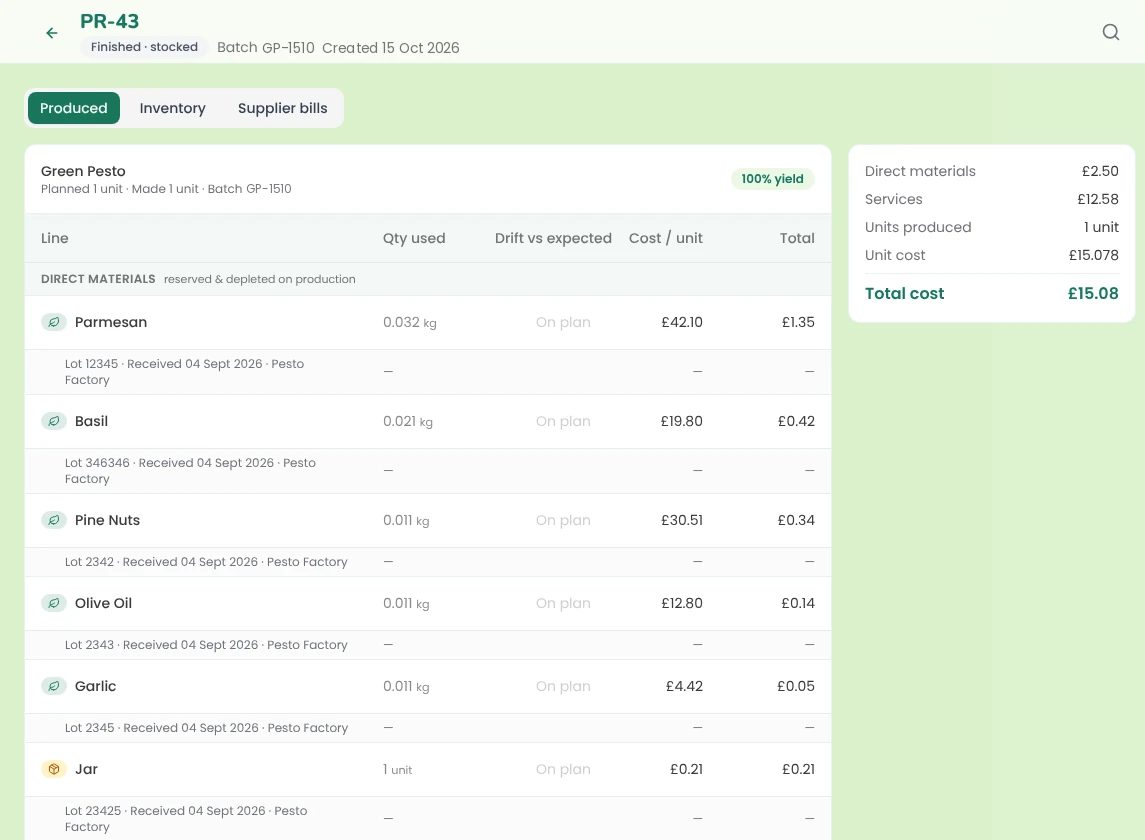
Enter last week's run: what the co-packer made, what it used and the canning fee. Pesto works out the unit cost from actual lot costs, shows yield against the BOM and drafts the Xero bill for the fee. Pesto raised each customer invoice in Xero as the order dispatched, in cases or units, from what actually shipped.
Friday afternoon's yours again.
How does Pesto track cans, labels and fees at the co-packer?
Every production run records where you made it: in-house or at a named co-packer, and at which location. Pesto reserves the materials you supply, such as cans, labels and outer cases, at the co-packer's location and depletes them from there. When you transfer stock to the co-packer, Pesto tracks it in transit, with shortage reasons if fewer arrive than you sent.
Some co-packers buy inputs themselves and bake them into their price. Pesto tracks those as shadow materials: left out of COGS, but used to show a theoretical full COGS so you can benchmark the co-packer's price. Canning and co-man fees sit as service lines, editable per run, and roll into the finished lot cost.
→ COGS & margins · → What is a co-packer ERP? · → Brands that make and use co-packers
How does Pesto handle cases, units, multipacks and mixed cases?
Each customer orders in cases, units or weight, and Pesto takes the order in whichever they use. A bill of materials sits behind each variant (single can, 4-pack, case, pallet, assortment) with its packaging included.
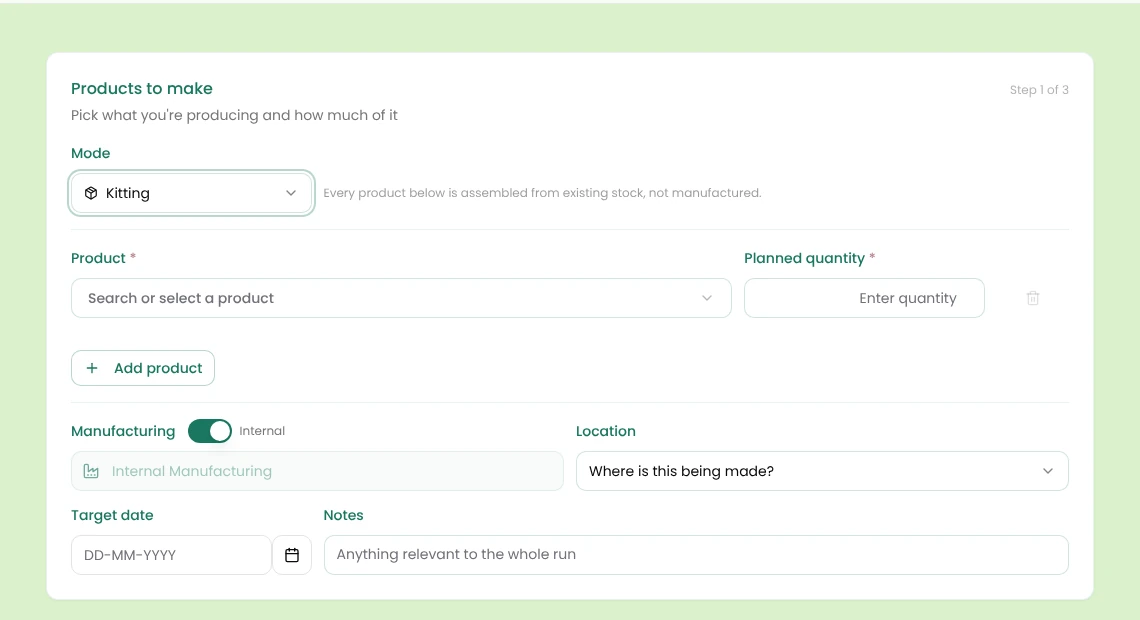
Multipacks take base units from single-unit lots, so a Shopify 4-pack takes four cans from stock. Kitting builds mixed cases and gift packs, and the component lot costs roll into the kit, so you know what the gift pack costs. On the invoice, you choose units or cases and can expand assortments.
How does Pesto handle best-before dates on retailer deliveries?
Every lot carries its batch code, supplier, location, best-before date and cost per unit. Pesto shows the shelf life left on each lot in days, months or percentage.
Minimum shelf-life rules apply by customer, customer type or product. One retailer wants 70% life remaining, the bottle shop takes anything in date, and Pesto applies the right rule to each order. You can also set a rule that holds every order until it has a batch code and date.
Traceability runs from finished lot to production run to the can and label lots and their suppliers, and forward to the orders and customers that received them.
What does a drinks brand say about Pesto?
Punchy Drinks takes orders as Word documents, PDFs and EDI notifications, with two warehouses shipping them.

"I was spending my time doing quite a monotonous, repeatable task, and we weren't ready to hire another exec to pass it on to."
Senior Operations Executive, Punchy Drinks
Frequently asked questions
Does Pesto work for beer, cider and spirits brands?
Yes, for orders, stock, batches, co-packer costing, planning and invoicing.
Can Pesto track my cans and labels at the co-packer?
Yes. Pesto reserves and uses up the materials you supply at the co-packer's location, tracks transfers in transit and records each run against the named co-packer.
Does Pesto connect to supermarket EDI?
Yes. Pesto connects to your retailer's EDI system, for example TrueCommerce, Supply Lens or XEDI, which carry orders from Ocado, Sainsbury's, Booths and other UK retailers.
Can bars, restaurants and independent shops order directly?
Yes. Pesto's B2B ordering portal is passcode-protected and branded, and each buyer sees their own catalogue and prices, with your minimum order value, shipping rules and terms.
How does Pesto handle samples and event stock?
Your team books samples, events and influencer drops through the send-out form against live stock, with your stock rules applied. Buyers can request samples through the sample request portal.
How long does it take to get set up?
Most brands go live in weeks, not months. We set up your products, BOMs, customers, price lists, co-packers and EDI with you.
See Pesto running on your own orders.
Bring a real PO, your messiest one. We'll show you what Pesto does with it in 30 minutes.
Book a demo