
Product
Food traceability software for UK brands: trace any batch, back and forward
Last updated: 16 October 2026
Pesto is food traceability software for UK food and drink brands. It traces any finished lot back to its production run, material lots and suppliers, and forward to every order and customer that received it. That gives you the one step back, one step forward records UK law asks for, and the trail for BRCGS and SALSA traceability tests.

What does UK law require for food traceability?
Retained Regulation (EC) 178/2002, Article 18, sets the legal baseline. Every food business must be able to identify:
- One step back: who supplied each food, ingredient or substance to you.
- One step forward: which businesses you supplied.
You must keep those records and hand them to the authorities on demand. People in the trade call this "one up, one down" traceability.
The Food Standards Agency's guidance on traceability, withdrawals and recalls goes further. It treats internal traceability (linking the ingredients that came in to the products that went out) as best practice rather than law. It also recommends keeping records for the product's shelf life plus 12 months, as a minimum.
So the law asks who sent you what and who you sent it to. Your retailers, and the standards they audit you against, ask for the bit in the middle.
What do BRCGS Issue 9 and SALSA Issue 7 ask for?
BRCGS Food Safety Issue 9
Clause 3.9.3
Quantity check
Four hours
Clause 3.11.3
SALSA Issue 7 (audits from 1 September 2026)
- Test traceability forwards and backwards at least once a year.
- No time target.
- Challenge-test your incident procedure at least once a year.
Both standards want proof you can do it, on a day you didn't plan for. That's what a mock recall is for.
How does Pesto trace a batch backward?
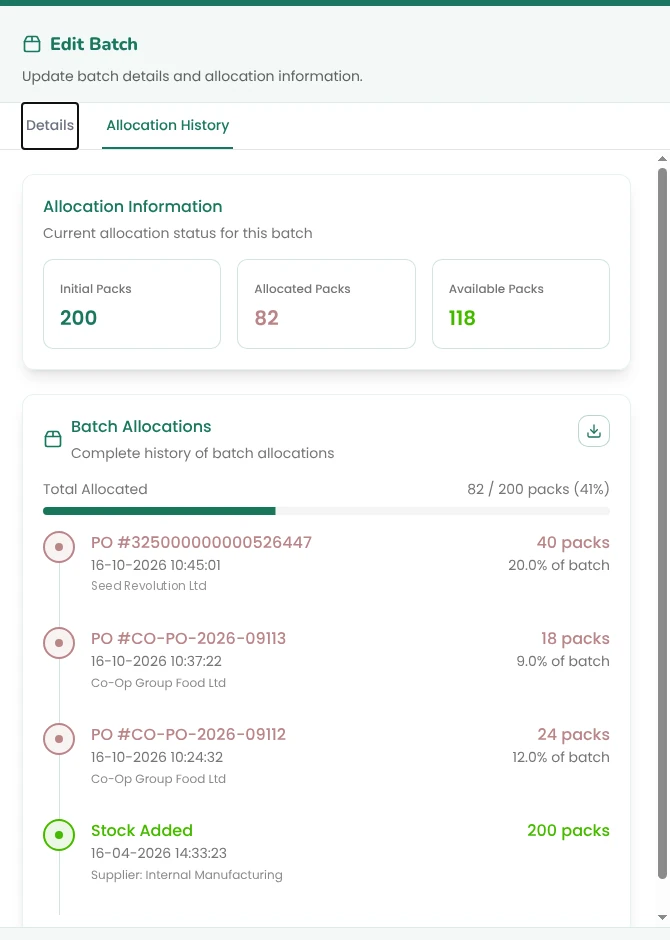
Every unit of stock in Pesto belongs to a lot, and every lot has a batch code. Start from a finished lot and Pesto shows:
Step 1
The production run
that made it, including where you made it: your own site or a named co-packer, and at which location.
Step 2
The material lots
that went into that run, each with its own batch code, received date and use-by.
Step 3
The suppliers
who sent each material lot.
If you buy in finished goods, the lot records its supplier, so one step back sits on the lot itself. If you build kits or gift packs, Pesto builds each one from specific component lots.
How does Pesto trace a batch forward?
From the same lot, Pesto shows every order that took stock from it and every customer who received those orders.
Because Pesto puts the batch code and use-by on every delivery note line, your paperwork and your customer's paperwork carry the same code. When a buyer's technical team asks which batch went to their depot, the answer matches what they already hold.
What does Pesto record for each lot?
Lot details
Shelf life remaining
The lot ledger
Adjustments with reasons
Production runs
How does Pesto stop stock leaving without a batch code?
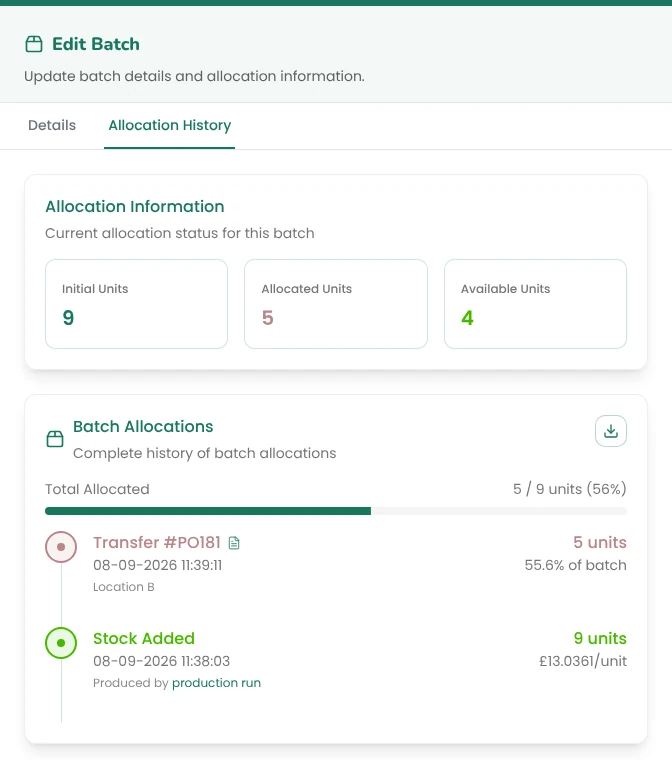
Traceability breaks at the point someone ships a pallet without writing down which batch it was. Pesto closes that gap.
No batch, no dispatch.
Batch codes on delivery notes.
FEFO picking.
Shelf-life rules.
How do you run a mock recall in Pesto?
Step 1
Start the clock
Pick a lot at random, or ask your auditor to pick one. Note the time.
Step 2
Trace backward
Open the finished lot. Pesto shows the production run, the material lots used and their suppliers. If your test starts from an ingredient, start from that material lot instead.
Step 3
Trace forward
From the finished lot, Pesto lists every order that took stock from it and every customer who received it.
Step 4
Check the quantities
Compare what the production run made with what you dispatched, what you adjusted and what's still in stock. The lot ledger shows every movement.
Step 5
Export the evidence
Download the lot ledger as CSV and attach it to your traceability test record.
Step 6
Stop the clock and review
Record how long the trace took against your target (four hours for BRCGS). Note any gap, such as a lot booked in without a batch code, and fix the process behind it.
Most of that is clicking, not searching. The hard part used to be finding the records. Now it's reading them.
Inventory
Brands that make their own
COGS & margins
Frequently asked questions
What is one up, one down traceability?
It's the legal minimum under Article 18 of retained Regulation (EC) 178/2002: you must know who supplied you (one step back) and who you supplied (one step forward), and show the authorities on demand. Pesto records both, plus the production run in between.
How often do BRCGS and SALSA require a traceability test?
At least once a year for both. BRCGS Issue 9 says full traceability should be achievable within four hours and includes a quantity check. SALSA Issue 7 sets no time target.
What is a mock recall?
A mock recall is a planned test of your traceability and recall procedure. You pick a batch, trace it back to its suppliers and forward to its customers, check the quantities and time how long it takes.
Can Pesto run a mass balance?
Pesto holds the numbers a mass balance needs: production run output and usage, every lot movement in the lot ledger, and adjustments with reasons. Your technical team reconciles them and signs the result off.
Does Pesto guarantee BRCGS or SALSA compliance?
No software can. Pesto gives you the traceability records and a fast way to search them. Your procedures, your team and your auditor do the rest.
Can I export traceability records?
Yes. Export any lot's ledger to CSV, with every movement from booking in to dispatch.
How long should I keep traceability records?
The FSA's guidance recommends at least the product's shelf life plus 12 months, as best practice. Pesto keeps each lot's full history in the lot ledger.
See Pesto running on your own orders.
Bring a real PO, your messiest one. We'll show you what Pesto does with it in 30 minutes.
Book a demoSources
- Retained Regulation (EC) No 178/2002, Article 18 (traceability). https://www.legislation.gov.uk/eur/2002/178/article/18
- Food Standards Agency and Food Standards Scotland, Guidance on food traceability, withdrawals and recalls within the UK food industry, March 2019. https://www.food.gov.uk/sites/default/files/media/document/food-traceability-withdrawals-and-recalls-guidance.pdf
- BRCGS, Global Standard for Food Safety Issue 9 (clauses 3.9.3 and 3.11.3). https://www.brcgs.com/documents-resources/food-safety-issue-9-standard/
- SALSA, new standard issues 2026 (Issue 7, audits from 1 September 2026). https://salsafood.co.uk/new-standard-issues-2026