
Glossary
What are shadow materials?
Last updated: 16 October 2026
Shadow materials are ingredients or packaging that your co-packer buys and builds into their price, which you never purchase yourself but track so you can benchmark what you're paying.
When a co-packer makes your product, you supply some inputs and they source the rest. The inputs they source are shadow materials. You don't buy them, hold them or pay a supplier for them. You record how much goes into each unit and what it should cost, so you can check whether the co-packer's per-unit price is fair.
Is "shadow materials" a standard industry term?
Not quite. "Shadow materials" is Pesto's term. In contract manufacturing you'll more often hear free-issue or customer-consigned materials (the ones you supply) and co-packer-supplied materials (the ones they buy). When you supply everything and pay only for the making, that's toll manufacturing. Shadow materials are the co-packer-supplied side.
Don't confuse them with a shadow spreadsheet: the side spreadsheet someone keeps because they don't trust the main system. Different problem, very common. → Excel alternatives for food manufacturing
In plain English: what does a shadow material look like?
Say you run a granola brand. A co-packer in the Midlands makes your 400g pouches. You buy the premium nuts (pecans and almonds) and the printed pouches, and deliver them to the co-packer's site. The co-packer buys the oats, mixes, bakes and packs, and charges you £0.95 a pouch.
The oats are your shadow material. Each pouch uses 220g of them. If you'd expect to pay around £0.90 a kg for oats, that's about £0.20 of oats inside every £0.95 you pay. So the co-packer charges roughly £0.75 a pouch for labour, baking, packing and their margin.
Now you've got something to work with. If oat prices fall and your co-packer's price doesn't, you can ask why. If a second co-packer quotes £0.70 a pouch with you supplying the oats, you can compare like with like.
(Illustrative numbers.)
Why do shadow materials matter?
Your co-packer's price is otherwise a black box.
Input prices move.
Your COGS stays honest.
You make better sourcing decisions.
How do you track shadow materials in practice?
Step 1
Put the shadow material on the recipe
Add it to the bill of materials (BOM) with its quantity per unit, just like an ingredient you buy.
Step 2
Give it a benchmark cost
Use a recent supplier quote, a market price or the figure your co-packer shares with you.
Step 3
Keep it out of COGS
Your real cost is the materials you supply plus the co-packer's fee. The shadow line is for reference only.
Step 4
Work out the conversion cost
Subtract the shadow cost from the co-packer's price per unit. What's left is what they charge for labour, overheads and margin, and that's the number to benchmark.
Step 5
Check it whenever prices change
Run the numbers again when your co-packer sends a new price list or a key input moves.
Related terms
- What is a co-packer ERP?: software for brands that outsource some or all of their production.
- What is COGS software for food brands?: how food brands cost each SKU and batch.
- Brands that make and use co-packers: how Pesto works when production happens in more than one place.
- All glossary terms
How does Pesto handle shadow materials?
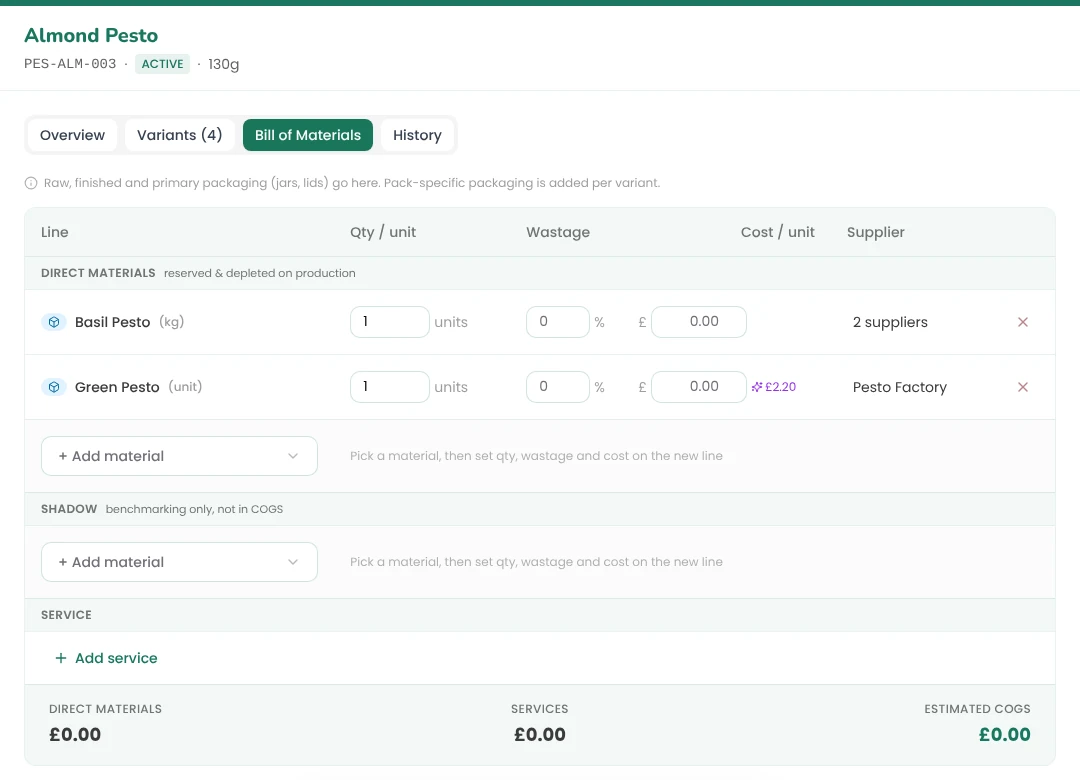
Pesto's bill of materials has a Shadow lane alongside Direct materials, Bought-in and Service (labour, co-man fees and logistics). A shadow line carries a quantity per unit and a cost, and Pesto leaves it out of COGS. Pesto then shows a separate figure, Theoretical full COGS (incl. shadow), so you can benchmark your co-packer's price.
Your co-man fees sit in the Service lane. You can update them on each production run with the actual figures, and they roll into the cost of the finished batch. → COGS & margins

Frequently asked questions
Are shadow materials part of COGS?
No. Your co-packer's fee already covers them, so counting them as well would overstate your cost of goods sold. Track them separately, as a benchmark.
What's the difference between shadow materials and free-issue materials?
You buy free-issue materials and send them to your co-packer. Your co-packer buys shadow materials. Most co-packed products use a mix of both.
Do I need to track shadow materials if my co-packer gives me a fixed price?
A fixed price is when tracking helps most. It hides input price changes, so the shadow cost shows you when the price has drifted away from what the inputs actually cost.
Will my co-packer tell me what they pay for shadow materials?
Some will, especially if you ask for a cost breakdown when you agree the contract. If yours won't, use a supplier quote or market price. A sensible estimate beats no number.
Can a spreadsheet track shadow materials?
Yes, for a handful of SKUs. It gets harder with several co-packers, recipe changes and price lists that update through the year, because the benchmark needs to sit next to the real cost of each batch.
See Pesto running on your own orders.
Bring a real PO, your messiest one. We'll show you what Pesto does with it in 30 minutes.
Book a demo