
Glossary
What is a co-packer ERP?
Last updated: 16 October 2026
A co-packer ERP is software that runs the operations around contract manufacturing, either for the co-packer itself or for the brand that outsources production to one.
The term means two different things. Co-packers use ERP software to schedule production and manage many clients' recipes. Brands that outsource to co-packers need something else: software that tracks the materials they send to the co-packer's site, the fees they pay per run, the true cost of each SKU and batch traceability through the co-packer.
What are the two meanings of "co-packer ERP"?
Software for co-packers. Contract manufacturers run many clients' products through shared lines, so they need production scheduling, capacity planning, recipes per client and billing per run.
Software for brands that use co-packers. The brand owns the recipe, the customers, the stock and the margin, but somebody else makes the product. The brand's software has to see into the co-packer's site without running it. The rest of this page covers this meaning.
In plain English: what does a co-packer ERP do for a brand?
Say you run a hot sauce brand. You make 150ml bottles in your Bristol kitchen, and a co-packer in Kent makes 1-litre foodservice bottles. You send them chilli mash and labels. They buy the vinegar and bottles, fill 3,000 units and invoice a run fee.
On spreadsheets, the chilli mash at the co-packer lives on a separate tab, someone keys the run fee into Xero and works out the cost per bottle once a quarter. With the right software, the mash sits at the co-packer's location as your stock. The run uses it up, the fee lands on that batch's cost, and the wholesaler's delivery note carries a batch code you can trace back to the chilli lot.
Why does a co-packer ERP matter?
Traceability doesn't stop at your door.
Co-man fees move your margin.
Stock at the co-packer is still your money.
Hybrid brands need one cost model.
What does a brand need from a co-packer ERP?
- Stock at the co-packer's site. Materials you supply show as stock at the co-packer's location, reserved for a run and used up by it.
- Shadow inputs. Inputs the co-packer buys sit on the recipe as a benchmark, outside COGS. → What are shadow materials?
- Per-run co-man fees. You record the actual fee for each run, not just the quoted rate.
- Supplier invoices. Invoices reach your accounting software without rekeying.
- True COGS per SKU. Your materials at the price you paid, plus fees, roll into each finished batch's cost. → What is COGS software for food brands?
- Customer orders linked to co-packer POs. You can see which run covers which order.
- Batch traceability through the co-packer. From a finished case back to every material lot, and forward to the customers who got it.
How does it work in practice?
Step 1
Add the co-packer as a location
Their site becomes one of your stock locations.
Step 2
Send materials
Transfer ingredients and packaging there, tracked in transit.
Step 3
Raise the PO
Place the run and link it to the customer orders it covers.
Step 4
Record the run
Log actual output, materials used and the fee charged.
Step 5
Match the invoice
Check it against the run and send it to your accounts.
Step 6
Sell the batch
The finished stock carries its true cost and traceability into every order.
How does Pesto handle co-packers?
We built Pesto for the brand side. Each production run records where the product was made (in-house or at a named co-packer) and at which location. Pesto reserves the materials you supply at the co-packer's location and depletes them when the run happens, and you can transfer stock there with in-transit tracking.
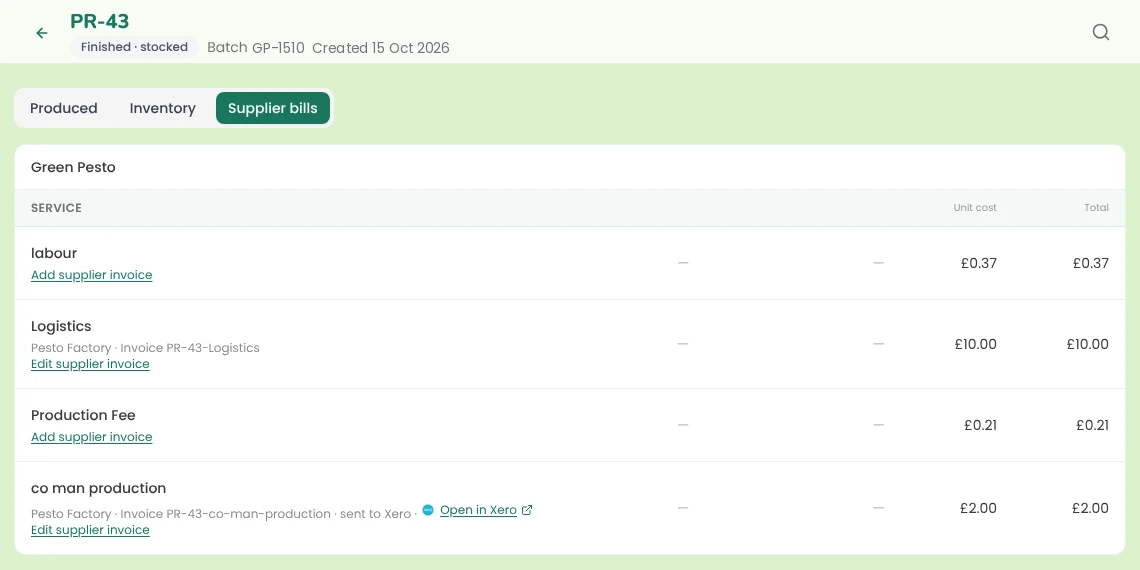
Co-man fees sit as Service lines on the recipe. You edit them per run with the actual figures, they roll into the finished lot cost, and Pesto drafts a Xero bill for each supplier invoice. Pesto links customer sales orders to supplier POs (AI suggests the matches) and traces every finished lot back to its material lots and suppliers, and forward to customers.
→ Brands that make and use co-packers · → COGS & margins · → Inventory

Frequently asked questions
Is a co-packer ERP the same as a contract manufacturing ERP?
Usually not. "Contract manufacturing ERP" normally means software for the manufacturer, built around scheduling and capacity. Brands that use co-packers need visibility of stock, fees, costs and traceability instead.
Do I need an ERP if a co-packer makes everything?
You still own the stock, the orders, the costs and the traceability. Your co-packer's system tracks their operation, not your margin by customer and SKU.
What's the difference between a co-packer and a co-manufacturer?
UK food brands use the two words interchangeably. Strictly, a co-packer sometimes only packs, while a co-manufacturer (co-man) makes the product too.
How do I track stock held at my co-packer's site?
Treat the site as one of your own locations. Record transfers in, let each run use the stock up, and count it with your co-packer regularly.
See Pesto running on your own orders.
Bring a real PO, your messiest one. We'll show you what Pesto does with it in 30 minutes.
Book a demo