
Glossary
What is FEFO?
Last updated: 16 October 2026
FEFO (first expired, first out) is a stock rule that sends out the batch with the earliest use-by or best-before date first, whatever order the batches arrived in.
FEFO means you pick the stock that expires soonest, not the stock that arrived first. For food brands it's the default way to cut waste: short-dated batches leave before longer-dated ones. Most brands pair FEFO with each customer's minimum shelf-life rule, so a batch that's too short for one customer goes to another.
What's the difference between FEFO and FIFO?
FIFO (first in, first out) ships the stock you received first. FEFO ships the stock that expires first.
Most days they pick the same batch. They split when a later delivery carries a shorter date: a co-packer run that sat in transit, or stock moved from another warehouse. Long-life ambient lines can run on FIFO. Chilled and short-life lines need FEFO.
In plain English: what does FEFO look like?
Say you sell a 200g hummus to a retailer and a handful of independent delis. Two lots sit in your chiller:
- Lot L2841: received 10 October, use-by 28 October.
- Lot L2845: received 12 October, use-by 24 October. It came from a co-packer run that sat in transit for a few days.
An order for 300 pots needs to reach the retailer's depot on 18 October, and the retailer asks for at least 7 days of life on delivery.
FIFO picks L2841, because it arrived first. FEFO picks L2845, because it expires first. But on 18 October L2845 has 6 days left, one short of the retailer's minimum. Send it and the depot can reject the whole delivery.
The right answer is FEFO plus a minimum-life rule. L2841 goes to the depot with 10 days left. L2845 goes to the delis, who'll take a shorter date, and it still leaves before L2841.
(Illustrative numbers. Each retailer's supplier manual sets its own minimum life on delivery.)
Why does FEFO matter for food brands?
Use-by is about safety.
Best before is about quality.
Retailers set a minimum life on delivery.
Write-offs come straight off margin.
Where does FEFO go wrong?
Picking from the front of the rack.
A 3PL running a different rule.
One rule for every customer.
Lots that don't cover the line.
How does FEFO work in practice?
Step 1
Record every batch at goods-in
batch code, use-by or best before, quantity and location.
Step 2
Set minimum life rules
per customer, and decide whether a breach warns you or blocks the pick.
Step 3
Allocate the earliest-dated batch
that still meets that customer's minimum.
Step 4
Pick what you allocated
Give the picker the batch code, not only the product.
Step 5
Print the batch on the delivery note,
so your customer can trace one step back to you.
It's unglamorous stuff, and it's where most short-dated waste starts.
Related terms
- What is a batch number?: the code FEFO sorts by, and the one you'll need in a recall.
- What is safety stock?: why short shelf life caps how much buffer you can hold.
- Inventory: batch tracking, FEFO and shelf-life rules in Pesto.
- All glossary terms
How does Pesto handle FEFO?
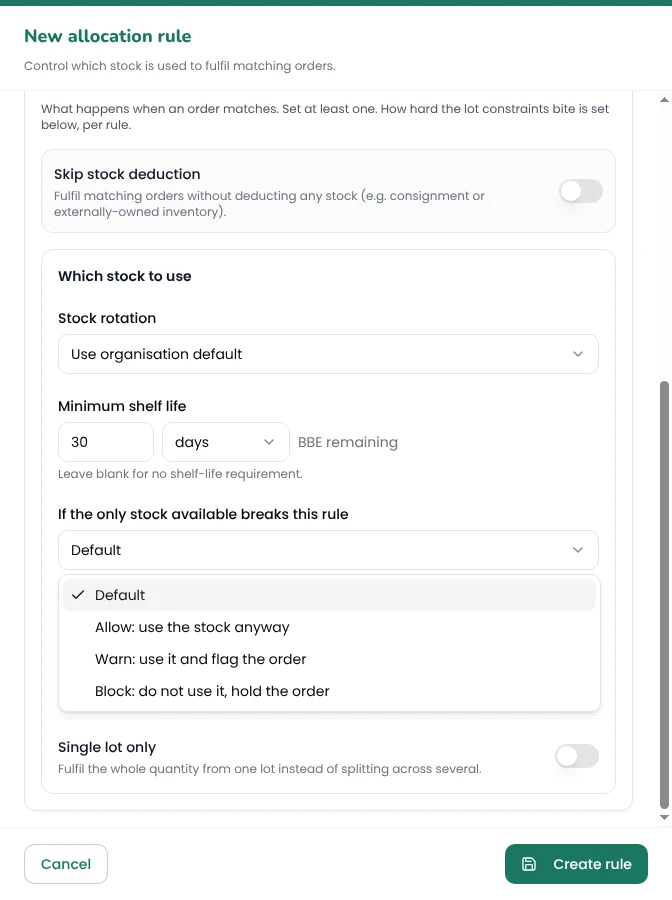
You choose FEFO or FIFO for your organisation. On top, Pesto's allocation rules apply by source, customer type, customer or product, and set a minimum shelf life with Allow, Warn or Block. Rules can also keep an order to a single supplier or a single lot.
When you pick, Pesto pre-selects lots by FEFO or FIFO, your allocation rules and location, and you can split a line across lots. Each lot shows its shelf life remaining in days, months or %, and every delivery note carries the batch code and use-by. → Inventory

Frequently asked questions
Is FEFO a legal requirement?
No. The use-by date is the legal limit. FEFO is the rule that stops you reaching it with stock still in the chiller.
Should I use FEFO or FIFO?
Use FEFO if any of your lines are chilled, short-life or arrive with mixed dates. FIFO works for long-life ambient stock where every delivery carries a similar date.
What's minimum shelf life on delivery?
It's the number of days, or share of total life, a product must have left when it reaches your customer. Each retailer and wholesaler sets its own figure, usually in its supplier manual.
Can a spreadsheet run FEFO?
For a few SKUs in one location, yes, if someone sorts by use-by before every pick. It breaks down with several warehouses, per-customer rules and lines split across batches.
See Pesto running on your own orders.
Bring a real PO, your messiest one. We'll show you what Pesto does with it in 30 minutes.
Book a demo