
Glossary
What is a batch number?
Last updated: 16 October 2026
A batch number (or lot number) is the code that ties a product to the run it came from, so you can trace every pack back to its ingredients and forward to the customers who received it.
A batch number, also called a lot number or batch code, identifies units made under the same conditions, usually one production run. UK law asks for a lot mark on most packaged food, though a use-by or best-before date can serve as one. Batch numbers let you trace one step back to suppliers and one step forward to customers.
Is a batch number the same as a lot number?
Yes. "Lot" is the legal word, from the Food (Lot Marking) Regulations 1996. "Batch" is what most factories say, and "batch code" is what's printed on the pack. Your suppliers' delivery notes will use all three.
What does UK law say about lot marks and traceability?
Lot marks.
The date-mark exemption.
One step back, one step forward.
How long to keep records.
Audits.
The exemption has a catch: two runs made on the same day share a date. Print a proper batch code and a recall pulls one run, not the whole day's output.
In plain English: what does a batch number look like?
Say you make a chilli sauce. On 16 October 2026 you fill 1,200 bottles and code the batch L26289: "L", then 26 for the year, then 289 for the day of the year.
That batch used chillies from supplier lot CH-0412 and bottles from lot GB-7731. The 1,200 bottles went out as 600 to a wholesaler, 480 to a retailer's depot and 120 through Shopify.
Two weeks later your chilli supplier calls: lot CH-0412 has a problem. With batch codes you can answer three questions fast:
Step 1
One step back
CH-0412 came from that supplier, on that delivery.
Step 2
Inside your business
CH-0412 went into L26289 and one later batch.
Step 3
One step forward
L26289 went to the wholesaler, the depot and 120 named Shopify customers.
Without batch codes you'd pull every bottle you'd sold that month.
(Illustrative numbers.)
Where do batch codes need to appear?
On the pack
At goods-in
On production records
On delivery notes
In your stock records
Why do batch numbers matter?
Recalls stay narrow.
Audits pass.
FEFO works.
Related terms
- What is FEFO?: how batch dates decide which stock leaves first.
- What is a bill of materials?: the recipe that links ingredient lots to finished batches.
- Traceability and recall: tracing any lot back and forward in Pesto.
- All glossary terms
How does Pesto handle batch numbers?
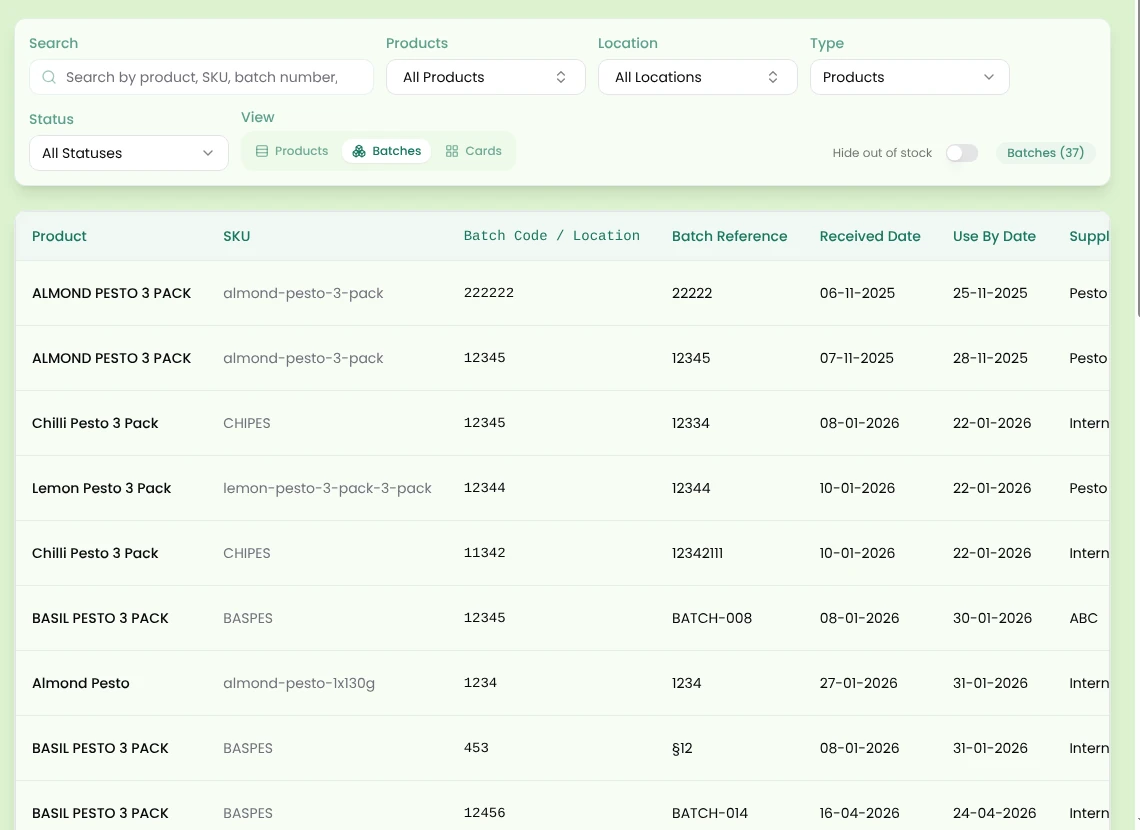
Pesto tracks every lot with its batch code, supplier, location, received date, use-by and cost per unit. You can book stock in by hand or upload a delivery note, spreadsheet, PDF or photo, and Pesto's AI pre-fills the details for you to check.
An optional rule stops anyone preparing an order without a batch code and use-by. Delivery notes carry both. Pesto traces any finished lot back to its production run, material lots and suppliers, then forward to every order and customer that received it, and the lot ledger exports to CSV. → Traceability and recall → Inventory

Frequently asked questions
Does every food product need a lot mark?
Food sold in a lot needs one under the Food (Lot Marking) Regulations 1996, unless the pack shows a use-by or best-before date with at least the day and month.
Can my best-before date be my lot mark?
Yes, if it shows at least the day and month. The catch: every run made that day shares one code, so a recall pulls the lot.
What's a good batch code format?
One that sorts by date and that anyone can decode. "L" plus the year and day of the year (L26289) works well. Add a suffix such as L26289A if you make more than one run a day.
Do batch codes need to go on delivery notes?
The law asks you to know who you supplied. A batch code on each delivery note also shows which lot each customer got, and that's what you'll need in a recall.
See Pesto running on your own orders.
Bring a real PO, your messiest one. We'll show you what Pesto does with it in 30 minutes.
Book a demo