
Glossary
What is COGS software for food brands?
Last updated: 16 October 2026
COGS software for food brands calculates what each product and each batch costs to make, using its recipe, the prices you actually paid for ingredients and packaging, and the fees and wastage involved.
Cost of goods sold (COGS) is what it costs you to make or buy each unit you sell. For a food brand that means ingredients, packaging, co-man fees, inbound freight, wastage and sometimes labour. COGS software keeps that number current as prices and yields change, and shows your margin by SKU and by customer.
What goes into COGS for a food brand?
Ingredients
Packaging
Co-man fees
Inbound freight and duty
Wastage and yield loss
Direct labour
Outbound delivery, listing fees and promotional funding usually sit below gross margin, though some brands count outbound delivery in cost of sales. Pick one rule and stick to it.
In plain English: how does COGS go wrong?
A chilled soup brand's costing sheet says a 600g pot costs £0.92 to make. Then butternut squash goes up 30% after a poor harvest, and the last few production runs yield 88% instead of the 95% the recipe assumes, because a new kettle catches more on the bottom.
The real cost per pot is now about £1.04. The sheet still says £0.92. The brand sells to a wholesaler at £1.35 a pot and thinks it's making 32% gross margin. It's actually making 23%. Nobody made a mistake. The sheet just stopped describing reality.
(Illustrative numbers.)
What's the difference between standard cost and actual cost?
Standard cost is what a unit should cost: recipe quantities at expected prices and yield. You use it for pricing and quoting.
Actual cost is what a specific batch did cost: the lots you used, at the prices you paid, divided by the units you got out. It shows your true margin.
The gap is your variance. It shows where money leaks: a supplier's price rise, a yield problem or a recipe someone's quietly changed.
Why does COGS software matter?
Spreadsheet costing drifts, for predictable reasons:
Ingredient prices change lot by lot.
Yield moves.
Recipes change without a record.
Customers pay different prices.
COGS software ties the cost to the actual batch and the selling price to the actual customer. That's how you get margin by customer and SKU you can trust, after the retailer's pricing, not before it.
How does batch costing work in practice?
Step 1
Build the recipe
List every ingredient, packaging item and service cost per unit, with wastage.
Step 2
Cost the stock as it arrives
Each lot you book in carries the price you paid.
Step 3
Record each production run
Log the lots you used, the output you got and any fees.
Step 4
Calculate the batch cost
Materials at actual lot cost, plus services, divided by units made.
Step 5
Carry the cost through to the sale
When you ship a case, the margin uses the cost of that batch and the price that customer pays.
How does Pesto handle COGS?
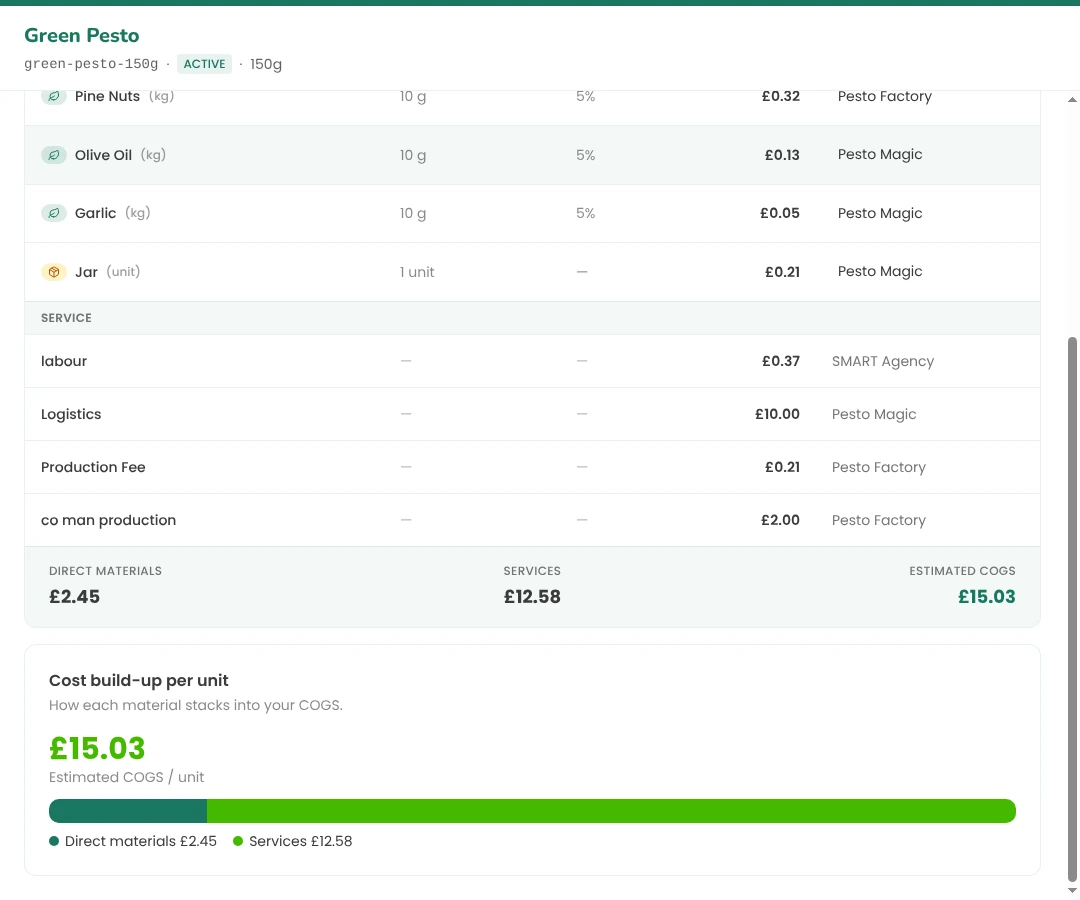
Pesto's bill of materials splits costs into lanes: Direct materials, Bought-in, Shadow (benchmark only, left out of COGS) and Service (labour, co-man fees and logistics), each with quantity per unit and wastage %. Pesto locks a new BOM version every time you save, with a reason, so your cost history stays readable.
Production runs record actual output, usage and service costs. Pesto works out unit cost as materials at actual lot cost plus actual services, divided by units, and shows yield % and usage drift against the BOM. Gross margin uses the actual lot cost of the stock allocated to each dispatched line, and the Gross Margin dashboard breaks it down by product, category and customer, with a margin bridge for price and mix, COGS per unit and volume. → COGS & margins

Frequently asked questions
Is COGS the same as cost of sales?
Mostly, yes. UK accounts usually say "cost of sales"; COGS is the same idea applied to physical products. Check with your accountant which costs they include.
Should co-man fees go in COGS?
Yes. A co-packer's fee is a direct cost of making the product, just like the ingredients.
What's the difference between COGS and landed cost?
Landed cost is the full cost of getting one input to your door: purchase price plus freight, duty and handling. COGS adds up the landed costs of every input in a unit, plus packaging, fees, wastage and labour.
How often should a food brand update its COGS?
Every batch, ideally. If you cost from a spreadsheet, review it at least whenever a key supplier changes price or a recipe changes.
Why does my spreadsheet margin differ from my accounts?
Usually because the spreadsheet uses standard cost and old prices, while your accounts reflect what you actually spent. Batch costing closes the gap.
See Pesto running on your own orders.
Bring a real PO, your messiest one. We'll show you what Pesto does with it in 30 minutes.
Book a demo