
Glossary
What is safety stock?
Last updated: 16 October 2026
Safety stock is the extra stock you hold on top of expected demand to cover the days when sales run higher or deliveries run late.
Safety stock is a buffer against two things: demand that runs above average and suppliers that deliver late. The standard formula multiplies a service-level factor (Z) by how much demand varies over your lead time. Add it to expected demand during the lead time and you get your reorder point.
What's the safety stock formula?
When demand varies but lead time is reliable:
Safety stock = Z × σD × √LT
When lead time varies too:
Safety stock = Z × √(LT × σD² + (Davg × σLT)²)
Z
σD
LT
Davg
σLT
Keep the units the same throughout. If you measure demand by the week, measure lead time in weeks.
(Formulas and Z-scores from King, APICS magazine, 2011.)
What Z-score goes with each service level?
| Service level | Z |
|---|---|
| 90% | 1.28 |
| 95% | 1.65 |
| 98% | 2.05 |
| 99% | 2.33 |
A 95% service level means enough stock to cover demand in 95 of every 100 order cycles. Each extra point costs more buffer than the last.
What's the reorder point?
Reorder point = (Davg × LT) + safety stock
When stock on hand, plus anything already on order, drops to the reorder point, you place the next order.
In plain English: what does safety stock look like?
Say you sell a chilled 200g hummus. A co-packer makes it, with a 3-day lead time.
- Average daily demand: 200 pots
- Standard deviation of daily demand: 60 pots
- Service level: 95%, so Z = 1.65
Safety stock = 1.65 × 60 × √3 = 171.5, so you round up to 172 pots. Lead-time demand is 200 × 3 = 600 pots, so your reorder point is 772 pots.
Now say the co-packer's lead time wobbles by a day either way (σLT = 1):
Safety stock = 1.65 × √(3 × 60² + (200 × 1)²) = 1.65 × √50,800 = 371.9, so 372 pots. The reorder point rises to 972.
One day of wobble more than doubled the buffer. A reliable co-packer is worth real money.
(Illustrative numbers.)
Why does shelf life cap safety stock for food?
The formula assumes stock keeps. Chilled food doesn't.
Take a slower line from the same brand: a 200g beetroot dip selling 20 pots a day, standard deviation 12, a 7-day lead time and a 98% service level (Z = 2.05).
- Safety stock = 2.05 × 12 × √7 = 65.1, so 66 pots
- Reorder point = 20 × 7 + 66 = 206 pots
- Usable shelf life on arrival: 8 days, so you can sell about 20 × 8 = 160 pots before they expire
The reorder point holds more than you can sell in date. Drop to a 90% service level and it's still 181 pots. The buffer isn't the problem: the 7-day lead time already uses most of the shelf life.
The fixes sit outside the formula: a shorter lead time, smaller and more frequent runs, or accepting the odd stockout on a slow line rather than binning stock every week.
(Illustrative numbers.)
Why does safety stock matter?
Stockouts cost more than the lost sale.
Too much buffer costs cash.
Short-dated buffer costs margin.
Related terms
- What is FEFO?: sending the earliest-dated stock out first, so buffer stock doesn't age at the back.
- What is MRP?: the planning sum safety stock feeds into.
- Demand planning & procurement: Stock Forecast and suggested orders in Pesto.
- All glossary terms
How does Pesto handle safety stock?
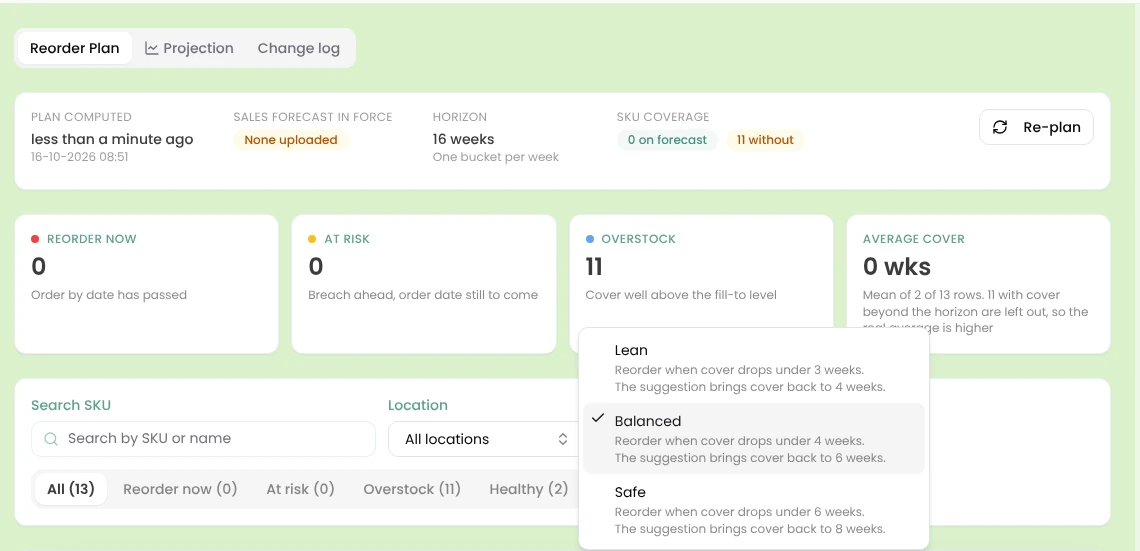
Pesto's Stock Forecast runs weekly per SKU and location from a sales forecast you upload. It flags each line as Reorder now, At risk, Overstock or Healthy, and suggests an order rounded to the case pack and MOQ. You set a risk posture of Lean, Balanced or Safe, and "Why this number?" shows how Pesto reached each suggestion. Pesto logs every decision you make on a suggestion.
The Stock Health dashboard shows days of cover plus stockout-by and order-by dates for every product. → Demand planning & procurement → Inventory

Frequently asked questions
How do I work out the standard deviation of demand?
Export daily sales for one SKU over the last 8 to 12 weeks and use STDEV.S in Excel or Google Sheets. Leave out days distorted by one-off promotions.
What service level should I choose?
95% is a common starting point. Go higher on lines a retailer would fine you for missing, and lower on slow or short-life lines where buffer turns into waste.
What's the difference between safety stock and the reorder point?
Safety stock is the buffer. The reorder point is the buffer plus the stock you expect to sell while you wait for the next delivery.
Should I hold safety stock on short-life chilled lines?
Hold some, but check the reorder point against what you can sell before the use-by. If it's higher, shorten the lead time or make smaller, more frequent runs before adding more buffer.
See Pesto running on your own orders.
Bring a real PO, your messiest one. We'll show you what Pesto does with it in 30 minutes.
Book a demo