
Glossary
What is MRP?
Last updated: 16 October 2026
MRP (material requirements planning) is the calculation that turns what you plan to make into what you need to buy and when, using your bills of materials and the stock you already hold.
MRP works out which materials to order, how much and by when. It takes your production plan, multiplies it through each bill of materials, subtracts the stock you hold and have on order, then counts back from supplier lead times. The output is a list of planned purchase orders and production runs.
How does APICS define MRP?
APICS (now ASCM), the supply chain body, defines MRP as "a set of techniques that uses bill of material data, inventory data, and the master production schedule to calculate requirements for materials."
In other words: what you'll make, what each unit needs and what you've already got.
What goes into MRP, and what comes out?
Inputs
The production plan
Bills of materials
Stock
Supplier terms
Outputs
Planned purchase orders
Planned production runs
Exceptions
In plain English: what does MRP look like?
Say you've booked a co-packer run of 4,000 jars of tomato and basil sauce on 20 November. Each jar's BOM uses 220g of tomatoes at 3% wastage, one jar at 2% wastage and 5g of fresh basil at 15% wastage.
Tomatoes
- Gross need: 4,000 × 220g × 1.03 = 906.4kg
- On hand: 150kg
- Net need: 756.4kg
- Supplier pack: 10kg, so 76 packs (760kg)
- Supplier MOQ: 100 packs, so you order 1,000kg and carry 243.6kg into the next run
- Lead time: 3 weeks, so the PO goes out by 30 October
Jars
- Gross need: 4,000 × 1.02 = 4,080 jars
- On hand: 1,500
- Net need: 2,580
- The supplier ships full pallets of 2,880, so you order one pallet and carry 300 jars forward
Basil
- Gross need: 4,000 × 5g × 1.15 = 23kg
- Fresh basil lasts days, not weeks, so you order it to land the day before the run, not with the tomatoes
(Illustrative numbers.)
That's three lines for one SKU. A range of 20 SKUs sharing tomatoes, jars and labels needs these sums for every shared material.
What's the difference between MRP, demand planning and ERP?
Demand planning
MRP
ERP
Why does food MRP need more than the textbook version?
Pack sizes
MOQs
Pallets and trucks
Shelf life
Cases vs units
Co-packers
Generic MRP handles the first line well. The rest is where food brands end up back in a spreadsheet.
Related terms
- What is a bill of materials?: the recipe data MRP multiplies through.
- What is safety stock?: the buffer MRP adds on top of the plan.
- Demand planning & procurement: how Pesto runs demand through to supplier POs.
- All glossary terms
How does Pesto handle MRP?
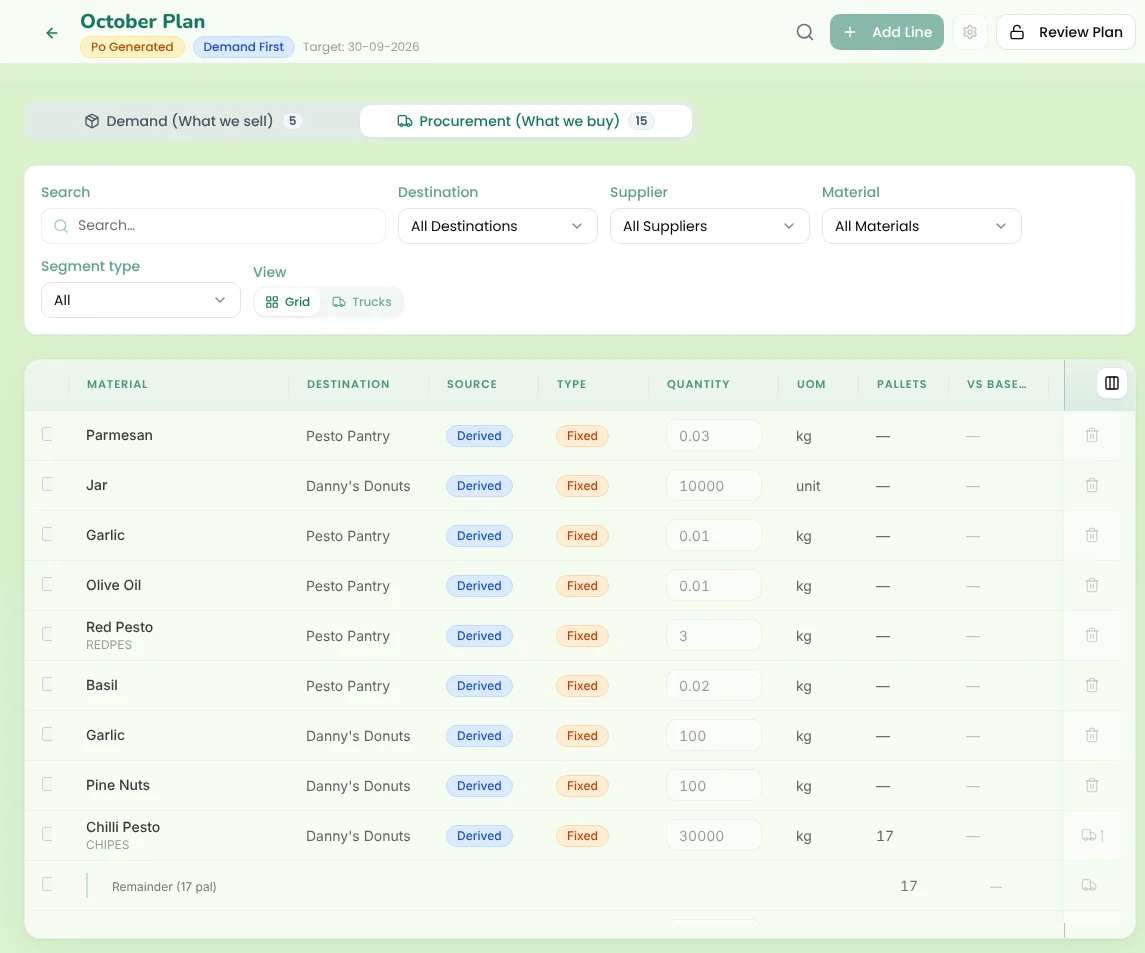
Pesto's demand planning runs the chain from demand to purchase order. You start a planning cycle as Demand First or Procurement First, and pull demand lines from sales orders in one click, enter them by hand or upload a SKU list. Pesto works your demand through each BOM into material needs per destination, and consolidates materials that several products share.
You can split a material across suppliers by %, in whole pallets. Pesto works out pallets from each supplier's quantity per pallet and packs them into trucks. When you validate and lock the plan, it generates draft POs per supplier, truck or material, converted into supplier packs: 4,200kg becomes 840 cases of 5kg. Manual POs warn you when you're under a supplier's MOQ. → Demand planning & procurement

Frequently asked questions
What does MRP stand for?
Material requirements planning. You'll also see MRP II (manufacturing resource planning), which adds machine and labour capacity to the same sums.
Is MRP the same as ERP?
No. MRP is the calculation that turns a production plan into material orders. ERP is the wider system that holds orders, stock, purchasing and finance, and MRP usually runs inside it.
Do I need MRP if a co-packer makes my products?
If you buy any of the ingredients or packaging, yes. You still need to get those materials to the co-packer before each run.
Can a spreadsheet do MRP?
For a few SKUs with no shared materials, yes. Shared ingredients, MOQs, pallets and shelf life turn it into the kind of workbook only one person understands.
See Pesto running on your own orders.
Bring a real PO, your messiest one. We'll show you what Pesto does with it in 30 minutes.
Book a demo