
Glossary
What is landed cost?
Last updated: 16 October 2026
Landed cost is the total cost of getting a product into your warehouse: the purchase price plus import duty, freight, insurance, handling and any other cost you pay to acquire it.
Landed cost is what a product costs you once it's sitting in your warehouse, not what the supplier's invoice says. Under IAS 2 it includes the purchase price, import duties and non-recoverable taxes, and freight, insurance and handling, less trade discounts. Import VAT usually stays out, because VAT-registered businesses can recover it.
What goes into landed cost?
IAS 2, the accounting standard for inventory, counts these as the cost of purchase (paragraph 11):
Purchase price
Import duties and other taxes you can't recover.
Transport
Insurance
Handling and other directly attributable costs
Less trade discounts, rebates and similar items.
Why isn't import VAT part of landed cost?
If you're VAT-registered, you can account for import VAT on your VAT return and recover it under the normal rules. It's a cash-flow item, not a cost. If you aren't VAT-registered, you can't recover import VAT, so it belongs in landed cost.
In plain English: what does landed cost look like?
Say you import a pallet from a European supplier:
- 1,200 bottles of 500ml extra virgin olive oil at €4.20
- 600 bottles of 250ml balsamic vinegar at €3.10
At €1 = £0.86, the goods cost £5,934.00. Then the extras arrive:
| Cost | Amount |
|---|---|
| Goods (£4,334.40 olive oil, £1,599.60 balsamic) | £5,934.00 |
| Freight | £450.00 |
| Insurance | £30.00 |
| Import duty at 6.5% of goods, freight and insurance | £416.91 |
| Customs broker fee | £95.00 |
| Port handling | £60.00 |
| Landed cost | £6,985.91 |
The extras add 17.7% to the invoice. Each bottle of olive oil cost £3.61 on the invoice and about £4.25 landed. Price it off £3.61 and you've lost 64p of margin on every bottle before it leaves the warehouse.
Import VAT sits outside the total either way. Most food, olive oil and vinegar included, is zero-rated, so this shipment carries none. If the same pallet held standard-rated goods at 20%, you'd pay £1,366.18 of import VAT and recover it on your VAT return.
(Illustrative numbers. The 6.5% duty rate is there to show the maths, not the tariff for olive oil: your rate depends on the commodity code and where the goods come from, and goods that meet a trade agreement's rules of origin can pay 0%.)
How do you allocate freight across lines?
One freight bill covers the whole pallet, so you need a rule to split it across products:
By value
By weight
By quantity
Here's what each method does to the landed cost per bottle in the shipment above, spreading freight, insurance, broker and handling fees:
| Method | Olive oil 500ml | Balsamic 250ml |
|---|---|---|
| By value | £4.25 | £3.14 |
| By weight (0.92kg and 0.45kg a bottle) | £4.29 | £3.06 |
| By quantity | £4.22 | £3.21 |
The total stays £6,985.91; only the split moves. Pick one method and stick to it, so your margins compare month to month.
Why does landed cost matter?
Margins on imported lines look better than they are.
Prices set from the invoice cost can leave a line making nothing.
Exchange rates move.
Related terms
- What is a bill of materials?: where your imported ingredients' landed cost ends up.
- What is COGS software for food brands?: how landed cost flows into cost per SKU.
- Demand planning & procurement: supplier POs in Pesto.
- All glossary terms
How does Pesto handle landed cost?
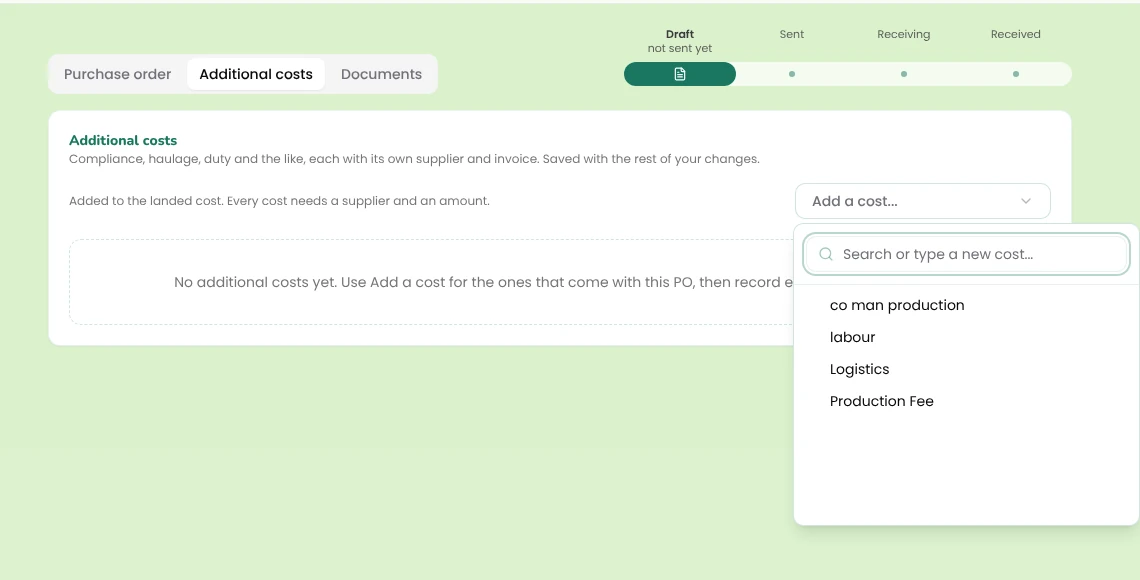
When you raise a supplier PO in Pesto, you can add additional costs such as haulage and duty to it. When you book the delivery in, each lot carries its own cost per unit, so you can enter the landed figure there. Pesto's gross margin then uses the actual lot cost of the stock allocated to each dispatched line. → Demand planning & procurement → COGS & margins

Frequently asked questions
What's the landed cost formula?
Landed cost = purchase price + import duty and non-recoverable taxes + freight + insurance + handling and other directly attributable costs, less trade discounts.
Is landed cost the same as COGS?
No. Landed cost is what you paid to get stock into your warehouse. COGS is the cost of the stock you sold, which for a manufactured product also includes the other ingredients, packaging and production costs.
Should import VAT go into landed cost?
Only if you can't recover it. VAT-registered businesses usually account for it on their VAT return, so it stays out.
Which allocation method should I use?
Weight suits freight on mixed loads. Value suits insurance and duty. If you want one method for everything, value is the simplest to defend.
See Pesto running on your own orders.
Bring a real PO, your messiest one. We'll show you what Pesto does with it in 30 minutes.
Book a demo